

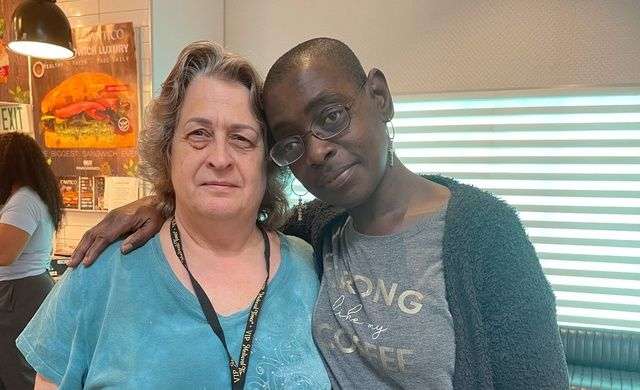
27 Years of Compassion: Meet Denise Sigmon, DSP of the Month
October 11, 2025
Posted by
Scott Peterson
27 Years of Heart: How One DSP Turned a Career Into a Calling
When Denise Sigmon walks into Bay Community Support Services' day center in Anne Arundel County, Maryland, she doesn't just see individuals with developmental disabilities. She sees language learners eager to master French. She sees reluctant readers who just need the right approach. She sees people who want to grow, learn, and be seen for who they truly are.
After nearly 27 years as a Direct Support Professional, Denise has mastered something that can't be taught in any training manual: the art of truly seeing people. Her journey through the disability services field has taken her from The Arc of Anne Arundel County to Providence Center and now to Bay Community Support Services, where she's spent the last two years transforming lives one individualized lesson at a time.
When Caregiving Runs in Your Blood
For Denise, becoming a DSP wasn't just a career choice. It was a calling rooted deep in her family's DNA. "I've always liked to take care of people because that's just the way I am," she explains. "My mom's that way, so I guess I take after her. My sister also did this type of work, so I guess it was in our blood." That natural inclination toward caregiving has shaped her entire professional life, extending not just to individuals with disabilities but also to elderly populations throughout her career.
What keeps someone in this demanding field for nearly three decades? According to Denise, it's simple: "That's because we love what we do." But her philosophy goes deeper than mere affection for the work. "To do this kind of work, you have got to love what you do, not just like it. You have got to love it," she emphasizes. "If I ever needed help or my children did, I'd want somebody to love what they do, because I know they would take care of my child or myself."
The Denise Difference: Personalized Learning
Denise's approach to support is anything but one-size-fits-all. When she arrives at the day center, she doesn't follow a rigid curriculum or predetermined schedule. Instead, she reads the room and reads the people. "I'd always go to different people and find out what they'd like to do," she explains. "I would pick certain things that they really like to do and I would act on them."
From French Lessons to Literacy Breakthroughs
One woman wanted to learn different languages, so Denise started teaching her French. "I'm not great at it," Denise admits with characteristic humility, "but she can read it and write it now. If she went to France, she'd make it. She could at least read and write." The pride in Denise's voice is unmistakable. It's not pride in her own teaching abilities, but genuine joy in her student's accomplishment.
Then there was the man who struggled with reading and was resistant to help. When asked if she could work with him, Denise encountered initial pushback. "At the beginning it was a little tough, but then I found a way that he liked," she recalls. She started with sight words and children's books, not because they were simple, but because they were accessible and built confidence. The transformation was so visible that another resident took notice and asked to join in. "He read pretty good, but he still was on a low level," Denise notes. Soon she had multiple students, each progressing at their own pace.
What makes these achievements particularly remarkable is that they weren't mandated goals or program requirements. These were organic connections built on trust, observation, and Denise's willingness to meet people exactly where they are. According to the National Institutes of Health, individualized support that respects autonomy and builds on personal interests is crucial for positive outcomes in developmental disability services. This is exactly the approach Denise has been practicing instinctively for decades.
The Foundation of Everything: Trust
When asked how she builds strong relationships with the individuals she supports, Denise's answer reveals the wisdom earned through years of experience: "You've got to earn their trust." She acknowledges the complexity of these relationships with refreshing honesty. "A lot of them are always at least one step ahead of you. But once you think you kind of know them, then that's when you just kind of work with it."
The proof of that trust is in the asking. When individuals specifically request Denise's help, it validates everything she works toward. "That really makes me feel good because they could have had anybody help them, but because they asked for me, that's very special." It's a simple measure of success, but perhaps the most meaningful one: being the person someone chooses when they're ready to take a risk and try something new.
Family members have taken notice too. Denise often sends videos of her teaching sessions to relatives, who express gratitude for seeing their loved ones engaged and learning. These small moments of connection ripple outward, strengthening not just the relationship between Denise and the individuals she supports, but also providing peace of mind to families who want to see their relatives thriving.
The Teacher Becomes the Student
What makes Denise exceptional isn't just her ability to teach. It's her willingness to learn. "I've kind of understood why some things are one way and some things are another," she reflects on her career progression from house manager to day center staff. "Just because we think we know stuff, we will always need to learn. Nobody can say they've learned everything."
One woman in particular has profoundly shaped Denise's perspective. "She's opened my eyes to a lot of things and has told me how to address them. I'm like, 'Oh my goodness, I've never thought that way.' So they help me as well." This mutual exchange, where support flows in both directions, represents the kind of reciprocal relationship that research shows leads to better outcomes for everyone involved.
Denise's work has even transformed how she approaches her personal life. She speaks candidly about her son, who she believes may be autistic though he's never been formally tested. "He's smart as a whip," she says proudly. "If I didn't do this kind of work, I would never have thought those things. But because I've done this kind of work, it's kind of made me see things I would have never seen before." Rather than pursuing a diagnosis or treatment, Denise applied what she learned from supporting individuals with disabilities: accept people as they are and support them in the way they need. "I've let him live his way, that he feels comfortable. He has friends. He's very smart. He's lived a normal life. He's never been on medicine or anything." According to the CDC, family members who work in disability services often develop enhanced understanding and acceptance that benefits their entire family system.
Shattering Misconceptions
When asked what people might not understand about her job, Denise addresses the fundamental misconception that keeps many from truly seeing individuals with disabilities. "Everyone's different. Just because we talk one way to somebody, we can't talk that same way to somebody else. And just because they might be disabled doesn't mean they're not like you and me."
It's a simple statement that cuts to the heart of person-centered care. Denise doesn't see disabilities first. She sees people with unique personalities, preferences, learning styles, and dreams. "They're like you. They just do things differently," she explains. This perspective shift, from viewing disability as a defining characteristic to seeing it as simply one aspect of a whole person, is what separates adequate support from transformative care.
"You have to really think of them. They're like you. They're just, they do things differently. And I guess we're not supposed to be friends, but they're hard not to be friends with them. Because some of them, they just teach you so much."
From Hands-On Care to Creative Engagement
Denise's career has spanned the full spectrum of direct support work. At Providence Center, she was "very, very hands-on," providing intimate care including changing diapers and feeding assistance. Her current role at Bay Community Support Services focuses more on skill-building and engagement. "This is kind of like a vacation for me here," she jokes, though her dedication remains unchanged.
The shift from physical caregiving to educational support hasn't diminished the intensity of her commitment. If anything, it's allowed her natural gifts as an educator and motivator to flourish. The woman who wants to learn languages, the men working on literacy skills. These individuals have found in Denise someone who believes in their potential and has the patience to help them realize it.
According to the Administration for Community Living, skill-building activities that align with individual interests and goals are essential components of quality disability services, contributing to greater life satisfaction and community integration.
The Passion That Can't Be Contained
When asked about her biggest challenge, Denise reveals something that her supervisor Natasha later confirms: sometimes Denise's passion for her work spills over. "I sometimes get too excited and then, you know, I have to bring it down," she admits. It's hardly a flaw. It's the overflow of someone who genuinely loves what she does and gets invested in the progress of the people she supports.
Natasha's assessment speaks volumes: "I've known Denise a little over two years now, and I've never questioned her skills. I've never questioned her love for what she does. Sometimes she may get a little overexcited, but we can work on that and she's come a long way with that. My main focus is I always see her involved teaching. She's assisting with activities of daily living as needed, and overall, she's a very, very good asset to the team."
In an industry plagued by high turnover rates, with some regions experiencing annual DSP turnover exceeding 40% according to recent industry data, Denise's 27-year career stands as a testament to what's possible when someone truly finds their calling.
Advice for Aspiring DSPs
For anyone considering a career in direct support, Denise offers straightforward wisdom: "You've got to love this kind of work instead of just liking it or it's just not a paycheck, because a lot of the individuals depend on you." It's not about the money or the benefits or even the sense of doing good. It's about genuine connection and commitment.
She emphasizes understanding over tolerance, connection over compliance. "If you don't understand the people, then it's not going to work. You have to really think of them as people." That fundamental shift in perspective, from seeing a job to seeing human beings, is what separates those who burn out quickly from those who, like Denise, build careers spanning decades.
The rewards of this perspective are immediate and profound. "There's one I love working with because she just wants to learn. She's always wanting to learn and it excites me when I do this kind of stuff and I'm able to do what I do, that I can really make a difference and I actually know that I am teaching her something." That knowledge, that concrete evidence of impact, is what sustains people like Denise through the challenges inherent in direct support work.
A Legacy of Love and Learning
Denise Sigmon represents everything a Direct Support Professional should be: patient, creative, committed, and endlessly compassionate. Across three different organizations and nearly three decades, she's refined her approach to supporting individuals with developmental disabilities, always keeping their humanity at the center of everything she does.
Her impact can't be measured solely in French vocabulary learned or reading levels improved. It's in the trust she's earned, the confidence she's built, the doors she's opened to new possibilities. It's in the videos that bring families joy and peace of mind. It's in the individuals who specifically ask for her help when they're ready to tackle something new.
At Bay Community Support Services' day center in Anne Arundel County, Denise continues to show up every day with the same philosophy that's guided her entire career: love what you do, see people as people, and never stop learning from those you're privileged to support. It's a simple approach that creates extraordinary results, one personalized lesson, one earned moment of trust, one breakthrough at a time.
Because after 27 years, Denise Sigmon still believes that if you truly love this work, it shows in every interaction, every teaching moment, every relationship you build. And the people she supports, the language learners, the reluctant readers, the ones who just needed someone to truly see them, they would all agree.
Nominate Your Amazing DSP Today
Help your outstanding Direct Support Professional get the recognition they deserve! Winner receives a $100 gift card and gets featured in our blog and newsletter.
• $100 gift card reward
• New: $250 in free training